
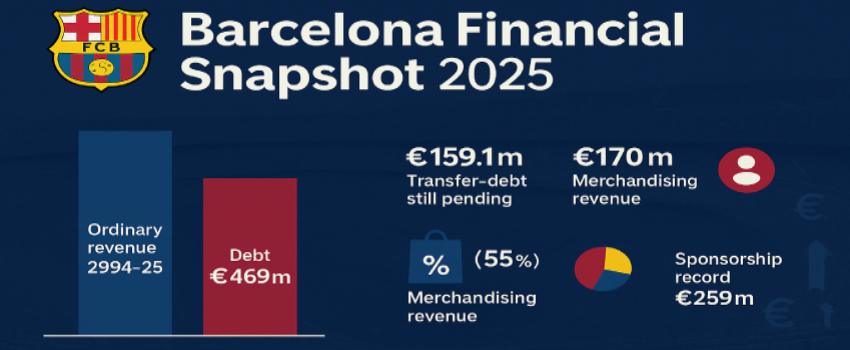
The narrative around FC Barcelona’s financial health is a complex one, swinging between record commercial growth and persistent debt. Barcelona football club’s 2024/25 financial documentation, published in October 2025, confirmed a headline figure: €159.1 million owed to other clubs for past transfers (widely framed as ~£138m at October 2025 rates), with €140.6 million due within 12 months. This front-loaded schedule creates a substantial cash-flow challenge that demands meticulous financial management and execution of the club’s ambitious recovery plan.
The current situation can be framed as a “recovery with caveats.” While the club has successfully restructured its long-term project debt and is driving revenue close to the €1 billion mark, the immediate financial future is defined by a race against the clock to meet those short-term payables and secure the timely, high-capacity reopening of the Spotify Camp Nou.


What the Accounts Show: Revenue Milestones and Net Loss
The accounts approved by the club assembly on October 19, 2025, reveal a club operating near the peak of its commercial potential despite ongoing stadium exile.
For the 2024/25 financial year, Barcelona achieved a major milestone: revenue reached €994 million. This top-line figure was achieved without full matchday revenue, powered instead by record sponsorship income (€259 million) and robust growth in merchandising (€170 million). The club also successfully maintained its wage-to-income ratio at approximately 54%, a key measure of cost control and regulatory compliance. The club reported that net debt fell to €469 million, an improvement of approximately €90 million year-on-year.
However, beneath the surface of operating strength, the bottom line suffered due to non-core activities. The ordinary operating result was a modest +€2 million profit, a significant achievement given the circumstances. But after accounting for extraordinary items—which notably included a UEFA fine of €15 million relating to Financial Fair Play (FFP) regulations, as well as accounting adjustments related to the PSL hospitality product—the result swung to a post-tax net loss of €17 million for the year.
This financial fragility was reinforced by external compliance pressures. LaLiga revised Barça’s squad cost limit downwards in April 2025 after excluding a large amount of VIP seat income that had been accounted for upfront. This move directly impacted the club’s registration flexibility, a constraint that carries into the 2025/26 season. LaLiga’s September update set Barça’s squad cost limit at €351m, down from €463m, explicitly citing the VIP seat income exclusion.
The €159.1 Million Transfer Payables: By the Numbers
The total outstanding transfer liability of €159.1 million represents the cumulative costs of purchasing players on instalment plans. While staggered payments are the industry norm, Barcelona’s situation is challenging due to the severity of the front-loading: €140.6 million is due within the 2025/26 season, creating an intense short-term cash-flow pinch. This figure is partially offset by the €64.1 million in transfer receivables owed to Barcelona from clubs like Porto, Al Ahli, and Shakhtar.
The club also reports €64.1 million in transfer receivables, including amounts due from Porto, Al Ahli and Shakhtar, which partially offsets the immediate cash burden. The specific amounts due can vary slightly depending on which financial outlet is reporting, but the core obligations are clear.
Who is Owed What? (Largest Creditors & Source Variances)
| Player | Selling Club | Primary Amount Owed (€) | Short-term/Variance Notes |
| Raphinha | Leeds United | €41.9m (~£36.5m) | Largest single balance; payment due over the next year. |
| Jules Koundé | Sevilla | €24.5m (~£22m) | Consistent figure across Spanish reporting. |
| Vitor Roque | Athletico Paranaense | €17.2m (~£15m) | Short-term obligation for the young forward. |
| Ferran Torres | Manchester City | €13.3m (~£12m) | Ongoing payments from the 2022 transfer. |
| Robert Lewandowski | Bayern Munich | €10.2m to €20.0m | Amount varies by Spanish source (Ara vs AS) based on whether all variables/instalments are counted. UK press often cites ~£8.5m to Bayern. |
| Dani Olmo | RB Leipzig | €19.0m to €33.7m | Discrepancy between short-term obligation (~€19m) and full short- and long-term debt (€33.7m, reported by Ara). |
This short-term pressure of €140.6 million means the club must generate cash and finalise its receivables flawlessly over the next 12 months. This is an operational mandate that must be met to avoid regulatory consequences or damage to its standing with creditor clubs.
How They Intend to Pay: Budgeting and Refinancing
The club’s repayment strategy is two-pronged, addressing both the immediate operating cash needs and the long-term project financing.
1. Operating Cash Flow and Receivables
For the 2025/26 season, the club assembly approved an aggressive budget projecting €1.075 billion in revenue, anticipating a modest net profit of approximately €4–5 million. This unprecedented revenue target, if achieved alongside the strict 54% wage ratio control, is intended to generate the free cash flow necessary to settle the transfer debts. The €64.1 million in transfer receivables will be a crucial asset here, directly offsetting a large portion of the payables.
2. Shrewd Project Debt Restructuring
On June 27, 2025, Barcelona executed a vital financial manoeuvre that separated the Camp Nou renovation project from the operating budget. The club refinanced €424 million of its Espai Barça debt via bond issuance. This restructuring was instrumental, pushing the first principal repayments to 2033 and extending the final maturity to 2050 at an average cost of 5.19%. This move protects the operating budget, allowing the cash generated from the €1.075 billion budget to be ring-fenced for salaries and transfer instalments, rather than stadium interest payments.
The long-term vision remains strong: once the Spotify Camp Nou is fully ramped up, the club projects it will generate €200 million in stadium-driven annual revenue, with some Spanish business press citing projections as high as €247 million. This future revenue is intended to service the long-term bond debt.
Camp Nou Setbacks and Why They Matter Financially
The biggest variable determining whether Barcelona meets its €140.6 million short-term obligation is the Spotify Camp Nou renovation project. The entire recovery plan is predicated on the return of high-capacity, high-revenue matchdays—a plan that has been severely undermined by delays.
The setbacks became public and concrete when the club’s bid to host matches at a partially reopened stadium was denied by city authorities on September 24, 2025, citing unresolved safety and evacuation issues. Works are currently reported to be approximately nine months behind schedule. The club confirmed their first LaLiga home match, vs. Valencia on September 14, 2025, would be played at the Estadi Johan Cruyff (6,000 capacity) due to permit and Montjuïc pitch availability constraints.
Barcelona planned a phased return—Phase 1A (~27,000), 1B (~47,000) and 1C (~60,000)—but permit denials and unfinished works pushed those targets back. Due to the permit denials and incomplete works, the club postponed its return, meaning the ~€50m stadium revenue uplift budgeted for 2025/26 is at risk if the partial return slips further, forcing a reliance on the later, higher-capacity phase.
These delays directly impact the 2025/26 budget. Every month the stadium remains closed, that revenue target is compromised, putting immediate stress on the cash reserve needed to meet those short-term transfer obligations. The reliability of the project timeline is therefore the cornerstone of Barcelona’s financial execution.
Risk Factors and What to Watch
While the long-term debt has been strategically managed, the short-term remains precarious.
The primary and most immediate risk factor is executing the plan to cover the €140.6 million short-term transfer payable. Any unexpected dip in commercial revenue or a further delay in the Camp Nou return could force the club to seek emergency financing, sell key players unexpectedly, or face scrutiny from LaLiga and creditors.
Financial Timeline at a Glance of Barcelona
| Date | Event | Financial Impact |
| April 2025 | LaLiga cuts Barça’s squad cost limit (due to VIP seat income exclusion). | Limited registration flexibility carries into 2025/26. |
| June 27, 2025 | €424m Espai Barça debt refinanced (repayments moved to 2033–2050). | Eases long-term pressure; protects operating cash flow. |
| Sept 24, 2025 | City denies permit for partial Camp Nou reopening (safety/evacuation issues). | Directly threatens the ~€50m stadium revenue budgeted for 2025/26. |
| Oct 19, 2025 | Assembly approves 2024/25 results and €1.075bn 2025/26 budget. | Sets the aggressive revenue target needed to cover short-term payables. |
Another critical area is LaLiga registration flexibility. The club must generate enough profit and cash reserves to satisfy LaLiga’s cost-control rules. If they fail to meet their budgeted targets, any potential transfer activity in the upcoming windows will be severely limited, forcing the club to rely heavily on player sales to balance the books and register new talent. The ability of the club to meet its payment milestones and get back into a high-revenue stadium will define the success of this delicate recovery phase.
The latest financial results confirm that FC Barcelona has navigated the initial crisis period with competence, achieving remarkable revenue growth and securing vital long-term debt refinancing. However, the immediate challenge is not about the long game; it’s about the €140.6 million due right now. The club is running a high-stakes, high-wire act where the successful completion and safe reopening of the Camp Nou renovation is the ultimate safety net. Until that stadium revenue normalises, every transfer payment and every LaLiga registration will be a test of their financial discipline.
Also Read: Zinedine Zidane Reflects On His Finest Real Madrid triumph
