
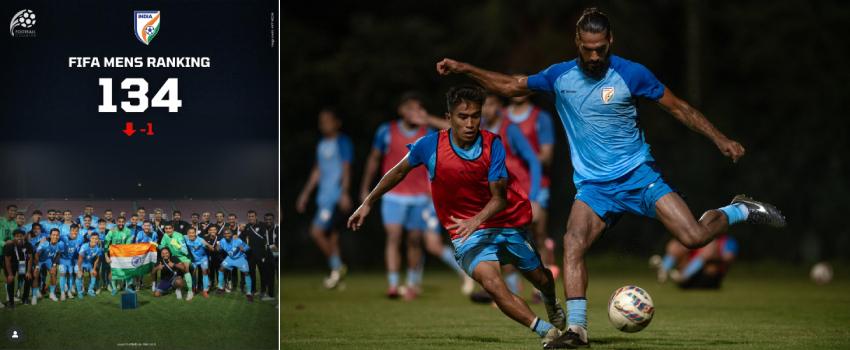
India football finds itself at a frustrating crossroads. The Blue Tigers have slipped one spot to 134th place in the latest FIFA rankings released on September 18, 2025, despite finishing third at the recent CAFA Nations Cup in Tajikistan. This drop comes at a time when the All India Football Federation continues to face administrative challenges that threaten the sport’s progress in the country.
The ranking decline feels particularly harsh given India’s decent showing in Dushanbe. Under coach Khalid Jamil, the team secured third place by beating Oman 3-2 on penalties after a hard-fought 1-1 draw. Udanta Singh’s 80th-minute equalizer, canceling out Jameel Al Yahmadi’s 55th-minute opener, showed the fighting spirit that Indian fans have been desperate to see. Yet somehow, this performance wasn’t enough to maintain their ranking position.


The Numbers Don’t Lie
India’s current 134th position puts them below their historical average of 129th place in the FIFA rankings. For context, the team’s highest-ever ranking was 94th, while their lowest point was 173rd. Being five spots below their average shows just how much work remains to rebuild Indian football’s international standing.
The drop is even more disappointing when you look at the regional picture. In Asia, India sits far behind the continent’s powerhouses – Japan (19th), Iran (21st), and Korea Republic (23rd). But it’s not just the traditional giants leaving India behind. Countries like Jordan (62nd), Vietnam (85th), and Oman (78th) are all significantly ahead. Even within South Asia, India’s position doesn’t reflect the country’s size and football potential.
To put this in global perspective, India now ranks behind nations like Nicaragua (132nd) and Congo (133rd). For a country with 1.4 billion people and growing football infrastructure, this is simply not good enough.
The Coaching Carousel Problem
One major factor in India’s struggles has been the constant coaching changes. The national team has resembled a revolving door over the past 18 months, and stability is impossible when you’re changing managers every few months.
Igor Štimac’s tenure ended on June 17, 2024, after a series of disappointing results in World Cup qualification. The Croatian had his moments but ultimately couldn’t deliver the consistency Indian football needed. His departure marked the beginning of an unstable period that continues to hurt the team’s development.
Manolo Márquez took over on July 20, 2024, bringing hope with his La Liga experience. But that experiment lasted less than a year. By July 2, 2025, both parties agreed to terminate the contract mutually. Reports suggest disagreements over tactical approach and player selection contributed to the split, though neither side has publicly criticized the other.
Now Khalid Jamil holds the reins, and while the third-place finish at the CAFA Nations Cup was respectable, the FIFA ranking drop shows there’s still much work ahead. Jamil knows Indian football inside out from his successful club career, but international football is a different beast entirely.
Breaking the Winless Streak
The most damaging period for India’s ranking was the 489-day winless streak that finally ended on March 19, 2025, with a 3-0 victory over Maldives. Think about that – the national team went over 16 months without winning a single match. That’s not just bad for rankings; it destroys confidence, fan support, and player morale.
During that streak, India played 18 matches, drawing some and losing many. Each game without a victory meant valuable ranking points slipping away. FIFA’s ranking system heavily weights recent results, so a streak like that creates a hole that takes years to climb out of.
The Maldives victory should have been a turning point, but five months later, India finds itself dropping further down the rankings. This shows that one win, or even a decent tournament performance, isn’t enough to fix systemic problems.
Spain Shows How It’s Done
While India struggles, Spain has reclaimed the world number one ranking for the first time since 2014. Luis de la Fuente’s team is on a remarkable 27-match unbeaten run – the second-longest streak in Spanish football history. They haven’t lost an official match since March 23, 2023.
The contrast is striking. Spain has consistency in coaching, clear tactical philosophy, and players who understand their roles perfectly. They don’t panic after bad results because they trust their system. India, meanwhile, changes coaches and tactics so often that players barely have time to adapt before everything shifts again.
Argentina, who held the top spot, slipped to third place behind France in second. Even world champions can lose their ranking position quickly in international football. But at least Argentina is falling from first to third – India is fighting to stay in the top 150.
The Ghost of 2022
Hanging over everything is the memory of India’s FIFA ban in August 2022. The suspension came due to third-party interference when a Supreme Court-appointed committee was running the federation. Though it lasted only 10 days, the damage to Indian football’s reputation was severe.
That ban showed how administrative chaos directly impacts on-field performance. Players can’t focus on football when they’re worried about whether their federation will exist tomorrow. Coaches can’t plan long-term when governance is unstable. Youth development suffers when nobody knows who’s in charge.
The threat of another ban continues to loom. FIFA and the Asian Football Confederation have repeatedly expressed concerns about AIFF’s governance structure. Until these administrative issues are fully resolved, Indian football can’t move forward properly.
What Needs to Change
First, India needs coaching stability. Give a manager at least two years to implement their vision. Constantly changing coaches means constantly starting from scratch. Look at successful national teams – they stick with coaches through rough patches because they understand building takes time.
Second, focus on youth development. India’s U-17 and U-20 teams need better support and more international exposure. The senior team’s ranking won’t improve unless younger players are developing properly. Countries like Vietnam have shown what’s possible when you invest in youth football.
Third, fix the domestic league structure. The Indian Super League and I-League situation remains confusing. Players need consistent, high-quality competition to improve. The domestic calendar should align with international windows to ensure the best players are always available for national team duty.
Also Read: India’s Road to FIFA Women’s World Cup 2027 & LA Olympic 2028
The Road Ahead
India’s 134th FIFA ranking is a reality check. The third-place finish at the CAFA Nations Cup shows the team can compete, but one decent tournament doesn’t fix years of problems. The coaching instability, administrative challenges, and lack of long-term planning have created a perfect storm of mediocrity.
The frustrating part is that India has everything needed for football success – passionate fans, improving infrastructure, and a huge talent pool to draw from. What’s missing is patience, stability, and clear direction. Until those elements come together, India will keep bouncing around the lower reaches of the FIFA rankings, wondering why a country of 1.4 billion people can’t produce a decent football team.
